Gingerbread House Recipe: Festive, Fun and Easy to Build
The kitchen smells like ginger and molasses, the icing bag is in your hand, and a little house is slowly taking shape on the table. That is the whole point of a gingerbread house. It is not about a perfect building. It is about an afternoon of baking, building and decorating with the people you love, and ending up with something sweet enough to eat and pretty enough to leave on display.
This gingerbread house takes 30 minutes of prep, 15 minutes in the oven, and 120 minutes of resting while the dough chills and the icing sets, which adds up to 165 minutes in total, and the recipe makes one house that serves 12. The dough is spiced with ginger and cinnamon, the walls bake up firm and flat, and the royal icing works like glue and snow at the same time. Make it on a December weekend, a school holiday, or any evening when you want a Christmas project that ends with candy on the roof.
Why You’ll Love This Gingerbread House
- Sturdy walls that hold their shape: The dough is rolled thick and baked until firm, so the walls stand up straight instead of bending or breaking.
- A warm, spiced flavour: Ground ginger, cinnamon and molasses give every piece a deep, old-fashioned Christmas taste.
- Royal icing that sets hard: Meringue powder makes the icing dry firm, so it glues the walls together and holds the candy in place.
- A project the whole family can join: One person builds, another pipes the icing, and the kids place the candy, so everyone has a job.
- Pretty enough for the table: Once it is decorated, this gingerbread house works as a centrepiece right through the holidays.
Read Also: Christmas Fudge

Ingredients You’ll Need
A good gingerbread house starts with dough that is firm enough to hold a wall, so measure the flour properly and do not skip the chill. Cold dough cuts cleanly and keeps its shape in the oven, while warm dough spreads and warps. Use unsulphured molasses for the best flavour, since blackstrap molasses tastes bitter here, and let the butter soften on the counter so the dough comes together smoothly. The royal icing uses meringue powder instead of raw egg whites, which keeps it safe and lets it dry hard and white.
Recipe Timing
| Servings | 12 servings |
| Difficulty | Medium |
| Course | Dessert |
| Cuisine | American |
| Prep Time | 30 minutes |
| Cook Time | 15 minutes |
| Rest Time | 120 minutes |
| Total Time | 165 minutes |
Ingredients
For the Gingerbread Dough
- 3 1/4 cups (390 grams) all-purpose flour: Gives the walls their structure, so the house stands up and stays firm
- 1 tablespoon ground ginger: Brings the warm, spicy flavour that makes the gingerbread house taste like Christmas
- 1 teaspoon ground cinnamon: Adds a soft sweetness that rounds out the ginger
- 1/2 teaspoon baking soda: Lifts the dough just enough so the pieces bake crisp without puffing up
- 1/4 teaspoon fine salt: Sharpens the spice flavour so the dough does not taste flat
- 1/2 cup (113 grams) unsalted butter, softened: Makes the dough tender and helps it roll out smoothly
- 3/4 cup (150 grams) light brown sugar, packed: Sweetens the dough and keeps the baked pieces a little chewy at the edges
- 1/2 cup (120 ml) unsulphured molasses: Gives the dough its dark colour and deep, old-fashioned flavour
- 1 large egg, at room temperature: Binds the dough together so the pieces hold their shape
- 1 teaspoon vanilla extract: Softens the spice with a gentle, warm background note
For the Royal Icing
- 4 cups (480 grams) powdered sugar, sifted: Forms the icing that glues the house together and pipes like snow
- 3 tablespoons meringue powder: Makes the icing dry hard and firm, so the walls stay put and the candy sticks
- 6 tablespoons water, plus more as needed: Thins the icing to a thick, pipeable consistency
- 1/2 teaspoon vanilla extract: Adds a light flavour so the icing tastes sweet instead of plain
For Decorating
- 1 cup mixed candy, such as gumdrops, peppermints and candy canes: Decorates the roof, windows and door with colour
- 1/2 cup mini marshmallows: Makes a snowy path or a pile of snow beside the door
- 2 tablespoons shredded coconut: Looks like fresh snow scattered on the base and the roof edges
Read Also: Christmas Brownies

Allergen & Dietary Disclosure
This gingerbread house contains wheat, from the flour, milk, from the butter, and egg, from the dough, so it is not suitable for anyone with those allergies as written, and the meringue powder in the icing is made from dried egg whites. It contains no nuts as written, though you should check the labels on your candy and sprinkles before serving. It is not guaranteed safe for any specific allergy. For a dairy free version, swap the butter for a firm plant based butter, though the dough will be a little softer to roll, and for a gluten free table, use a cup for cup gluten free flour blend and roll the dough a little thicker so the walls stay strong.
Equipment Needed
- Rolling pin: Rolls the dough to an even thickness, which keeps the walls flat and straight.
- House template cut from card: Gives you the two walls, two roof pieces and two gable ends in the right sizes.
- Baking sheets lined with parchment paper: Stop the pieces from sticking and make them easy to lift off once baked.
- Piping bag with a small round tip: Pipes the royal icing in neat lines along the edges and the roof.
- Sturdy cake board or flat plate: Holds the finished gingerbread house steady while you build and move it.
- Cooling rack: Lets the baked pieces cool flat and firm before you start assembling.
Step-by-Step Directions
Step 1: Make the Gingerbread Dough
Whisk the flour, ground ginger, cinnamon, baking soda and salt together in a medium bowl. Beat the softened butter and brown sugar in a large bowl until pale and fluffy, about 2 minutes, then beat in the molasses, egg and vanilla until smooth. Add the flour mixture in two parts and stir until a stiff dough forms with no dry patches left. Chef’s Note: if the dough feels sticky, add flour one tablespoon at a time, since a dough that is too soft will spread in the oven and give you crooked walls.
Step 2: Chill the Dough
Divide the dough into two flat discs, wrap each one tightly in plastic wrap, and chill them in the fridge for at least 1 hour. Cold dough is the secret to this gingerbread house, because it cuts cleanly around the template and holds its shape while it bakes. You can chill the dough overnight if you want to split the work across two days, just let it sit on the counter for 10 minutes before rolling so it does not crack.
Step 3: Roll Out and Cut the House Pieces
Heat your oven to 350°F (175°C) and line two baking sheets with parchment paper. Roll one disc of dough on a lightly floured surface to about 1/4 inch thick, then lay your card template on top and cut around it with a sharp knife to make the walls, roof pieces and gable ends. Move each piece to the baking sheet with a wide spatula so it stays flat, and cut a door and windows into the front wall before baking if you like. Chef’s Note: roll the dough the same thickness everywhere, since a thin corner will burn while a thick spot stays soft.
Step 4: Bake the Pieces Until Firm
Bake one sheet at a time for 12 to 15 minutes, until the edges look set and the surface feels firm when you press it gently. Let the pieces cool on the sheet for 5 minutes, then move them carefully to a cooling rack and let them cool completely. The pieces should feel hard and flat once cool, which is exactly what you want, because soft pieces will bend when the house goes together.

Step 5: Make the Royal Icing
Beat the powdered sugar, meringue powder, water and vanilla together in a large bowl on low speed for 2 minutes, then on medium speed for 3 minutes, until the icing is thick, white and holds a stiff peak. The icing should be thick enough to stay on the spoon without dripping, since thin icing will run off the walls and the house will slide apart. Cover the bowl with a damp cloth while you work, because royal icing crusts over fast in open air. Chef’s Note: if the icing feels too stiff to pipe, add water half a teaspoon at a time, since a little water goes a long way here.
Step 6: Assemble the Gingerbread House
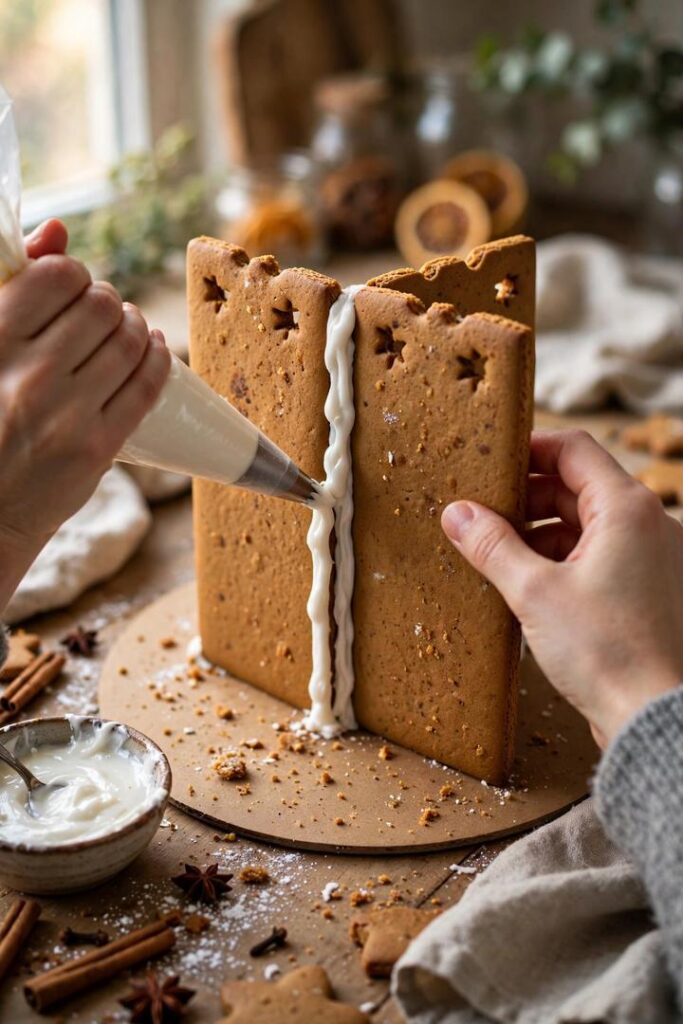
Pipe a thick line of icing along the bottom edge of one side wall and press it onto the cake board, then pipe icing up the side edge and press the front gable end against it. Hold each piece in place for a minute or two until the icing starts to grip, and use a small jar or a can to prop the walls up while you add the rest. Add the second side wall and the back gable the same way, then leave the house to set for 30 minutes before you touch the roof. Once the walls feel solid, pipe icing along the top edges and set the two roof pieces in place, holding them until they stay on their own.
Step 7: Decorate and Let the Icing Set
Pipe icing along the roof ridge and the edges so it looks like snow, then press gumdrops, peppermints and candy canes onto the roof while the icing is still soft. Add a door, windows and a snowy path with the icing and the mini marshmallows, then scatter shredded coconut around the base for snow. Leave the finished gingerbread house to set for at least 1 hour before you move it, since the icing needs that time to dry hard and lock everything in place.
Common Mistakes & Troubleshooting
Most gingerbread house problems come down to soft dough, thin icing, or rushing the assembly before the icing has set.
| Problem | Cause | Solution |
|---|---|---|
| Walls bend or break | Dough rolled too thin, or not chilled enough | Roll the dough to 1/4 inch thick and chill it for a full hour before cutting |
| House slides apart | Icing too thin, or walls not held long enough | Beat the icing until it holds a stiff peak, and hold each wall for 1 to 2 minutes |
| Roof pieces slide off | Walls not set before the roof went on | Let the walls set for 30 minutes first, then pipe a thick line along the top edges |
| Pieces spread in the oven | Dough too warm, or too much baking soda | Chill the cut pieces for 10 minutes before baking, and measure the baking soda carefully |
| Icing crusts in the bag | Icing left uncovered in open air | Keep the bowl covered with a damp cloth, and pipe in small batches |
| Candy falls off the roof | Icing already set when the candy went on | Press the candy in while the icing is still soft, and add a fresh dab of icing behind heavy pieces |
Variations & Substitutions
- Mini gingerbread house: Cut the template pieces half size and build a small house that one child can decorate alone.
- Chocolate gingerbread house: Swap 1/4 cup of the flour for cocoa powder for a dark, chocolate spiced house.
- Spicier gingerbread house: Add 1/2 teaspoon of ground cloves and a pinch of black pepper to the dough for a stronger spice flavour.
- No candy version: Decorate with piped icing only, using dots, swirls and icicles, for a snowy white house with no sweets.
- Gingerbread house cookies: Roll the leftover dough scraps and cut them into stars and trees for extra biscuits.
- Peppermint roof: Crush candy canes and press the pieces into the icing on the roof for a red and white striped look.
Serving Suggestions
Set the finished gingerbread house on the Christmas table as a centrepiece and let everyone break off a piece with their hands, since a gingerbread house is meant to be pulled apart and shared, not sliced neatly. Serve it with hot chocolate, spiced cider, or a mug of milky coffee, and put a small plate of extra candy and gingerbread cookies beside it so guests can snack while they admire the house.

Tips for the Best Results
- Chill the dough properly: A full hour in the fridge is the minimum, since cold dough is what keeps the walls straight and flat.
- Roll the dough evenly: Check the thickness with your fingers as you roll, because uneven dough bakes into wavy walls.
- Bake the pieces a little firm: The pieces should feel hard when they cool, since soft gingerbread bends under the weight of the roof.
- Make the icing thick: Royal icing should hold a stiff peak, or it will not grip the walls of your gingerbread house.
- Build in stages: Let the walls set for 30 minutes before adding the roof, since patience here is what keeps the house standing.
- Keep the icing covered: A damp cloth over the bowl stops the royal icing from crusting while you decorate.
- Decorate while the icing is wet: Press the candy in right after you pipe, so it sticks instead of sliding off dry icing.
Storage Tips
Refrigerator
Keep the finished gingerbread house in a cool, dry room rather than the fridge, since the cold and damp will soften the icing and the walls. If you need to store it, cover it loosely with plastic wrap and keep it at room temperature for up to 1 week, away from heat and steam.
Freezer
Freeze the unbaked dough discs, wrapped tightly, for up to 2 months, and thaw them in the fridge overnight before rolling. You can also freeze the baked, undecorated pieces in a flat container for up to 1 month, with parchment paper between the layers, then thaw them at room temperature before assembling.
Reheating
There is no reheating for a gingerbread house, since the icing would melt and the house would fall apart in a warm oven. If the pieces feel soft after storage, warm them in a 300°F (150°C) oven for 5 minutes to crisp them up, then let them cool completely before you build or decorate.
Nutrition Information
Values are per serving, one twelfth of the house, served as written.
- Calories: 420
- Carbohydrates: 72 grams
- Protein: 4 grams
- Fat: 13 grams
- Saturated Fat: 7 grams
- Cholesterol: 45 milligrams
- Sodium: 180 milligrams
- Sugar: 46 grams
- Fibre: 2 grams
- Calcium: 45 milligrams
- Iron: 2 milligrams
- Vitamin C: 0 milligrams
Nutrition values are approximate and may vary based on brands and portion sizes.
Why This Recipe Works
This gingerbread house works because the dough is built for structure first and flavour second. The flour and molasses make a firm, flat piece that dries hard in the oven, the chill keeps the cut edges sharp, and the bake time is long enough to set the walls without burning them. Nothing in the dough is there by accident, since the ginger and cinnamon carry the flavour while the butter and brown sugar keep the pieces from tasting dry.
The royal icing does two jobs at once, and both matter. Meringue powder lets it dry hard enough to glue the walls and hold the roof, while the thick, white icing pipes like snow and gives the house its finished look. Building in stages, walls first, then a rest, then the roof, means each joint is set before the next load goes on, which is why this house stands up instead of sliding apart.
Read Also: Peppermint Bark
Frequently Asked Questions
How far ahead can I make a gingerbread house?
You can bake the pieces up to a week ahead and keep them in an airtight container at room temperature, then build and decorate the house one or two days before you need it. The dough discs also freeze well for up to 2 months. Do not assemble the house more than a few days ahead, since the icing softens over time in a damp room and the walls can start to lean.
Why did my gingerbread house fall apart?
The icing was probably too thin, or the roof went on before the walls had set. Royal icing needs to hold a stiff peak to work as glue, and the walls need a full 30 minutes to set before you add the roof. Build in stages, hold each wall for a minute or two while the icing grips, and prop the walls with jars or cans until the joints feel solid.
Can I use store bought gingerbread dough?
Yes, a firm store bought gingerbread dough works if you chill it well and roll it to 1/4 inch thick. Check that it is a construction style dough, not a soft cookie dough, since soft dough spreads in the oven and the walls will come out wavy. The homemade dough in this recipe is firmer, so it gives you straighter walls with less trouble.
How do I keep the icing from running off the walls?
Beat the icing until it is thick enough to hold a stiff peak, and test it by lifting the beater, since the icing should stand up in a point, not flop over. If it drips off the spoon, beat in more sifted powdered sugar a tablespoon at a time. Keep the bowl covered with a damp cloth while you work, and pipe in small batches so the icing in the bag stays fresh.
Can I make this gingerbread house without meringue powder?
You can, but the icing will not set as hard, so the house will be weaker. A pasteurised egg white icing is the closest swap, using 2 egg whites beaten with 4 cups of powdered sugar, though it dries softer and takes longer to set. For the sturdiest gingerbread house, meringue powder is the better choice, since it dries firm and holds the candy in place.
Is this gingerbread house safe for kids to help with?
Yes, this is a great project for kids, and the royal icing here uses meringue powder instead of raw egg whites. Let an adult handle the hot oven and the sharp knife for cutting the pieces, and give the kids the decorating, since piping icing and placing candy is the fun part. Small children should not eat large amounts of raw dough, so keep the tasting until the pieces are baked.
Conclusion
A gingerbread house is less a recipe and more a Christmas afternoon, and this one is built to be enjoyed, not stressed over. The dough bakes up sturdy, the icing sets hard, and the decorating is where the house becomes yours, with candy on the roof and snow on the windows. Build it slowly, let each stage set before the next, and you will end up with a house that stands tall on the table.
Once the house is finished and the icing has dried, put it where everyone can see it and let people break off a piece when they want one. For another festive bake from the same kitchen, try our Christmas Brownies when you want a rich, chocolatey treat to go with the gingerbread. A gingerbread house earns its place at Christmas, and this one is ready for the table.

Gingerbread House
Ingredients
Method
- Make the Gingerbread Dough: Whisk the dry ingredients, beat the butter and sugar with the molasses, egg and vanilla, then stir in the flour to form a stiff dough.
- Chill the Dough: Divide the dough into two discs, wrap tightly, and chill in the fridge for at least 1 hour.
- Roll Out and Cut the House Pieces: Roll the dough to 1/4 inch thick, cut the walls, roof pieces and gable ends around a card template, and place them on lined baking sheets.
- Bake the Pieces Until Firm: Bake at 350°F (175°C) for 12 to 15 minutes, then cool on the sheet for 5 minutes before moving to a rack.
- Make the Royal Icing: Beat the powdered sugar, meringue powder, water and vanilla until thick, white and holding a stiff peak.
- Assemble the Gingerbread House: Pipe icing along the wall edges, press the walls and gable ends onto the board, let them set 30 minutes, then add the roof pieces.
- Decorate and Let the Icing Set: Pipe icing snow on the roof, press the candy in place, add the door, windows and coconut snow, then leave the house to set for 1 hour.